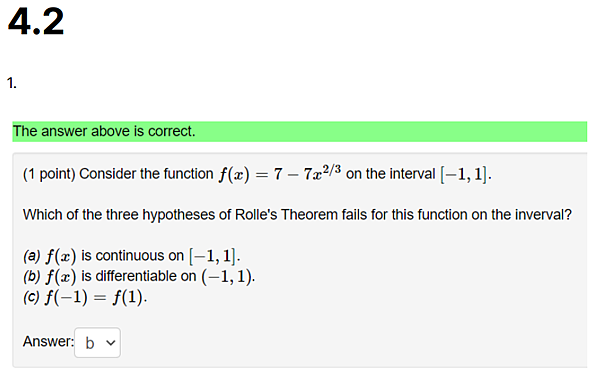


Consider the function f(x)=7−7x2/3 on the interval [−1,1].
Which of the three hypotheses of Rolle's Theorem fails for this function on the inverval?
(a) f(x) is continuous on [−1,1].
(b) f(x) is differentiable on (−1,1).
(c) f(−1)=f(1).
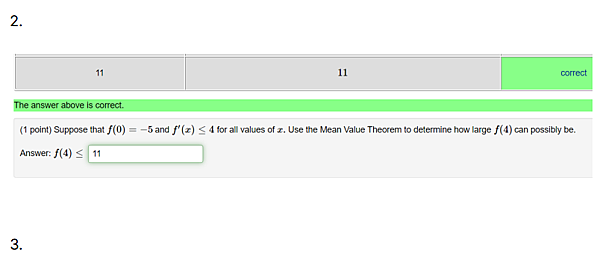
Suppose that f(0)=−5 and f′(x)≤4 for all values of x. Use the Mean Value Theorem to determine how large f(4) can possibly be.
Answer: f(4)≤
Suppose that f(t) is continuous and twice-differentiable for t≥0. Further suppose f′′(t)≤9 for all t≥0 and f(0)=f′(0)=0.
Using the Racetrack Principle, what linear function g(t) can we prove is greater than f′(t) (for t≥0)?
g(t)=
Then, also using the Racetrack Principle, what quadratic function h(t) can we prove is greater than than f(t) (for t≥0)?
h(t)=
For both parts of this problem, be sure you can clearly state how the theorem is applied to prove the indicated inequalities.
Consider the functions f(x)=ex−1−1 and g(x)=x−1. These are continuous and differentiable for x>0. In this problem we use the Racetrack Principle to show that one of these functions is greater than the other.
(a) Find a point c such that f(c)=g(c). c=
(b) Find the equation of the tangent line to f(x)=ex−1−1 at x=c for the value of c that you found in (a).
y=
(c) Based on your work in (a) and (b), what can you say about the derivatives of f and g?
f′(x) g′(x) for 0<x<c, and
f′(x) g′(x) for c<x<∞.
(d) Therefore, the Racetrack Principle gives
f(x) g(x) for x≤c, and
f(x) g(x) for x≥c.

請先 登入 以發表留言。